.svg)
.svg)
The Power of Agile Project Management with Workflow
This blog post explores the synergy between Agile principles and structured workflows, revealing how this powerful combination can elevate your team's performance and project outcomes.
 Alexia Holder
 Jessica Patel
 Obadea Gbenga
June 12, 2025
Productivity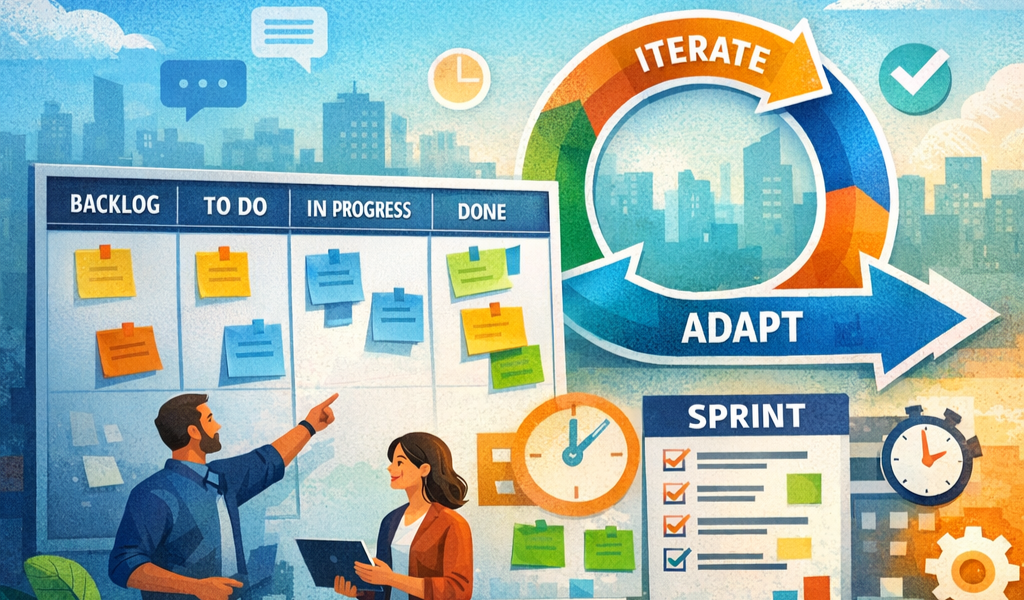
In today's fast-paced digital landscape, traditional project management methodologies often fall short of meeting the dynamic demands of modern teams. Enter Agile Project Management—a revolutionary approach that has transformed how organizations deliver value, adapt to change, and foster collaboration. When combined with well-defined workflows, Agile becomes an unstoppable force that drives productivity, transparency, and continuous improvement.
What is Agile Project Management?
Agile project management is an iterative approach to planning and guiding project processes. Unlike traditional waterfall methods that follow a linear, sequential path, Agile embraces
- Iterative Development: Breaking projects into smaller, manageable increments called sprints
- Continuous Feedback: Regular check-ins with stakeholders to ensure alignment
- Adaptive Planning: Flexibility to pivot based on changing requirements
- Cross-functional Collaboration: Teams working together across disciplines
- Customer-Centric Focus: Prioritizing user needs and delivering value early and often

The Agile Manifesto: Core Values
The foundation of Agile rests on four key values:
1. Individuals and interactions over processes and tools
2. Working software over comprehensive documentation
3. Customer collaboration over contract negotiation
4. Responding to change over following a plan
Understanding Workflows in Agile
A workflow is the sequence of processes through which a piece of work passes from initiation to completion. In Agile, workflows are visual representations of how tasks move through different stages, providing clarity and structure to the iterative process.
Common Agile Workflow Stages
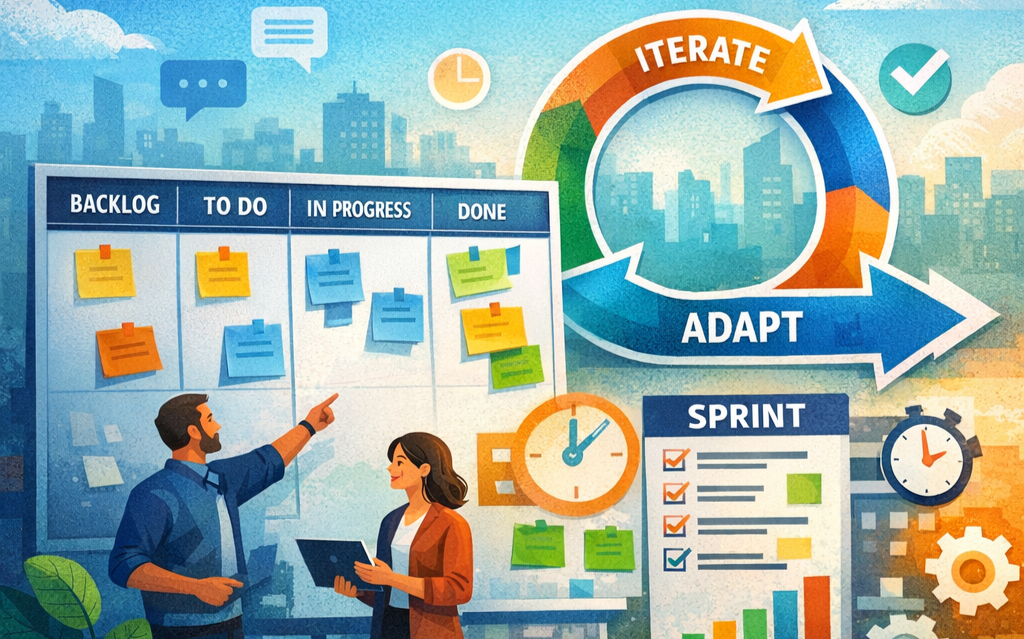
1. Backlog: Ideas and requirements waiting to be prioritized
2. To Do: Tasks selected for the current sprint
3. In Progress: Active work being developed
4. Review/Testing: Quality assurance and validation
5. Done: Completed and delivered work
Popular Agile Frameworks with Workflows
Scrum
Scrum uses time-boxed sprints (typically 2-4 weeks) with defined ceremonies:
- Sprint Planning
- Daily Stand-ups
- Sprint Review
- Sprint Retrospective
Kanban
Kanban focuses on continuous flow and visualization:
- Visual board with columns representing workflow stages
- Work-in-progress (WIP) limits to prevent bottlenecks
- Continuous delivery without fixed iterations
Scrumban
A hybrid approach combining Scrum's structure with Kanban's flexibility, perfect for teams transitioning between methodologies.
The Power of Combining Agile with Workflows
1. Enhanced Visibility and Transparency
Workflows make the invisible visible. When your team uses a visual board (physical or digital), everyone can see:
- What work is in progress
- Who is working on what
- Where bottlenecks exist
- How close you are to sprint goals
Real-world Impact: A software development team at a mid-sized tech company reduced their "where are we on this?" meetings by 60% after implementing a Kanban board, freeing up 5+ hours per week for actual development work.
2. Improved Collaboration and Communication
Agile workflows create a shared language for teams. Instead of lengthy status reports, team members can:
- Update task cards in real-time
- Add comments and attachments directly to work items
- Tag colleagues for input or review
- See dependencies between tasks at a glance
Pro Tip: Use color coding in your workflow to indicate priority levels, task types, or team assignments for even faster visual processing.
3. Faster Identification of Bottlenecks
When work piles up in one stage of your workflow, it's immediately apparent. This visibility enables:
- Quick intervention to redistribute resources
- Process improvements to eliminate recurring obstacles
- Data-driven decisions about capacity planning
Example: If your "Review" column is consistently overflowing, you might need to:
- Add more reviewers to the team
- Implement automated testing to reduce manual QA
- Break down tasks into smaller, more reviewable chunks
4. Continuous Improvement Through Metrics
Agile workflows generate valuable data that drives improvement:
- Cycle Time: How long tasks take from start to finish
- Lead Time: Time from request to delivery
- Throughput: Number of tasks completed per sprint
- WIP: Number of tasks in progress simultaneously
Actionable Insight: Track these metrics over multiple sprints to identify trends. A gradual increase in cycle time might indicate growing technical debt or team burnout.
5. Flexibility and Adaptability
The beauty of Agile workflows is their inherent flexibility. Unlike rigid project plans, workflows can be:
- Adjusted mid-sprint if priorities change
- Customized to fit your team's unique needs
- Scaled up or down as projects evolve
Case Study: A marketing agency shifted from a traditional project timeline to an Agile workflow when a major client requested significant changes mid-campaign. Instead of starting over, they reprioritized their backlog, adjusted sprint goals, and delivered the revised campaign on time—something impossible with their old approach.
Implementing Agile Workflows: Best Practices
1. Start Simple, Then Iterate
Don't try to implement the perfect workflow on day one. Begin with basic stages:
- To Do
- In Progress
- Done
As your team matures, add stages that reflect your actual process (e.g., Code Review, Testing, Staging, Production).
2. Define Clear "Done" Criteria
Ambiguity kills productivity. For each workflow stage, establish clear criteria for when a task can move forward:
Example "Done" Criteria for Development:
- Code written and self-reviewed
- Unit tests written and passing
- Code reviewed by at least one peer
- Documentation updated
- No critical bugs or security issues
3. Limit Work in Progress (WIP)
One of Kanban's most powerful principles is WIP limits. By restricting how many tasks can be in a given stage simultaneously, you:
- Encourage task completion over task starting
- Reduce context switching
- Highlight capacity constraints
Recommended Starting Point: Limit WIP to 1.5x the number of team members per stage.
4. Make Your Workflow Visible to Everyone
Whether you use a physical board in your office or a digital tool like Jira, Trello, or Asana, ensure:
- The board is always up-to-date
- Everyone has access and knows how to use it
- It's referenced in daily stand-ups and planning meetings
5. Regularly Refine Your Workflow
Your workflow should evolve with your team. During sprint retrospectives, ask:
- Are our workflow stages still accurate?
- Do we need to add or remove stages?
- Are our WIP limits appropriate?
- What workflow changes would improve our efficiency?
Tools for Agile Workflow Management
Digital Tools
1. Jira: Industry standard for software development teams, highly customizable
2. Trello: Simple, visual, great for smaller teams or simpler projects
3. Asana: Excellent for cross-functional teams with multiple project types
4. Monday.com: Highly visual with strong automation features
5. Azure DevOps: Comprehensive for teams in the Microsoft ecosystem
6. ClickUp: All-in-one solution with extensive customization
Physical Boards
Don't underestimate the power of a physical Kanban board:
- Tactile interaction increases engagement
- Always visible in the workspace
- No login required
- Great for co-located teams
Hybrid Approach: Many successful teams maintain both a physical board for daily visibility and a digital tool for remote team members and historical tracking.
Common Challenges and Solutions
Challenge 1: Resistance to Change
Solution:
- Start with a pilot team before rolling out company-wide
- Celebrate early wins publicly
- Provide training and ongoing support
- Involve skeptics in the design process
Challenge 2: Workflow Becomes Too Complex
Solution:
- Regularly audit your workflow for unnecessary stages
- Remember: the workflow should serve the team, not vice versa
- If team members are confused, simplify
Challenge 3: Inconsistent Updates
Solution:
- Make board updates part of your daily routine (e.g., during stand-ups)
- Assign a "board master" to ensure accuracy
- Use automation where possible (e.g., automatic status updates from GitHub)
Challenge 4: Metrics Obsession
Solution:
- Remember that metrics are tools for improvement, not weapons for judgment
- Focus on trends over individual sprint performance
- Use metrics to ask questions, not assign blame
Real-World Success Stories
Spotify: Scaling Agile with Squads and Tribes
Spotify's famous "Spotify Model" uses Agile workflows at scale:
- Squads: Small, cross-functional teams with end-to-end responsibility
- Tribes: Collections of squads working in related areas
- Chapters: Groups of people with similar skills across squads
- Guilds: Communities of interest across the organization
Each squad maintains its own workflow, adapted to its specific needs, while sharing best practices across the organization.
ING Bank: Agile Transformation
ING Netherlands restructured its entire organization around Agile principles:
- Eliminated traditional hierarchies in favor of squads and tribes
- Implemented Kanban workflows across all teams
- Reduced time-to-market for new features by 30%
- Increased employee engagement scores significantly
The Future of Agile Workflows
AI and Automation
Emerging technologies are enhancing Agile workflows:
- Predictive Analytics: AI predicting sprint capacity and potential delays
- Automated Task Assignment: Intelligent routing based on skills and availability
- Smart Notifications: Context-aware alerts that reduce noise
- Natural Language Processing: Creating tasks from meeting notes or emails
Remote and Hybrid Work
The shift to distributed teams is driving innovation in workflow tools:
- Virtual Reality Boards: Immersive collaboration spaces
- Asynchronous Workflows: Designed for teams across time zones
- Integration Ecosystems: Workflows that connect seamlessly with all your tools
Continuous Everything
The future is continuous:
- Continuous Integration
- Continuous Delivery
- Continuous Deployment
- Continuous Feedback
Workflows are evolving to support this always-on approach to development and delivery.
Conclusion: Embracing the Power
The combination of Agile project management and well-designed workflows is more than just a methodology—it's a mindset shift that empowers teams to:
✅ Deliver value faster through iterative development
✅ Adapt to change with flexibility and confidence
✅ Collaborate more effectively with transparency and shared understanding
✅ Improve continuously through data-driven insights
✅ Increase satisfaction for both team members and customers
Whether you're a startup building your first product, an enterprise transforming legacy processes, or anywhere in between, Agile workflows provide the structure and flexibility needed to thrive in today's dynamic environment.
The question isn't whether to adopt Agile workflows—it's how quickly you can start experiencing their transformative power.
Getting Started: Your Action Plan
Ready to harness the power of Agile workflows? Here's your roadmap:
Week 1: Learn and Assess
- Read the Agile Manifesto and principles
- Assess your current project management approach
- Identify pain points and opportunities
Week 2: Design and Prepare
- Choose an Agile framework (Scrum, Kanban, or Scrumban)
- Design your initial workflow stages
- Select your tools (digital, physical, or both)
Week 3: Pilot and Iterate
- Launch with a single team or project
- Hold daily stand-ups to review the board
- Gather feedback and make adjustments
Week 4: Review and Expand
- Conduct your first retrospective
- Refine your workflow based on learnings
- Plan expansion to additional teams
Additional Resources
Books
- "Scrum: The Art of Doing Twice the Work in Half the Time" by Jeff Sutherland
- "Kanban: Successful Evolutionary Change for Your Technology Business" by David J. Anderson
- "The Phoenix Project" by Gene Kim, Kevin Behr, and George Spafford
Online Courses
- Scrum.org: Professional Scrum Master Certification
- Coursera: Agile Development Specialization
- LinkedIn Learning: Agile Foundations
Communities
- Agile Alliance
- Scrum Alliance
- Local Agile meetups and user groups
About the Author
This blog post was created to help teams understand and leverage the powerful combination of Agile methodologies and structured workflows. Whether you're just starting your Agile journey or looking to optimize your existing processes, the principles outlined here can help you achieve better outcomes, happier teams, and more satisfied customers.
Have questions about implementing Agile workflows in your organization? Want to share your own success story? Let's continue the conversation in the comments below!
Tags: #AgileProjectManagement #Workflow #Scrum #Kanban #ProjectManagement #TeamCollaboration #ContinuousImprovement #SoftwareDevelopment #ProductivityHacks #AgileTransformation